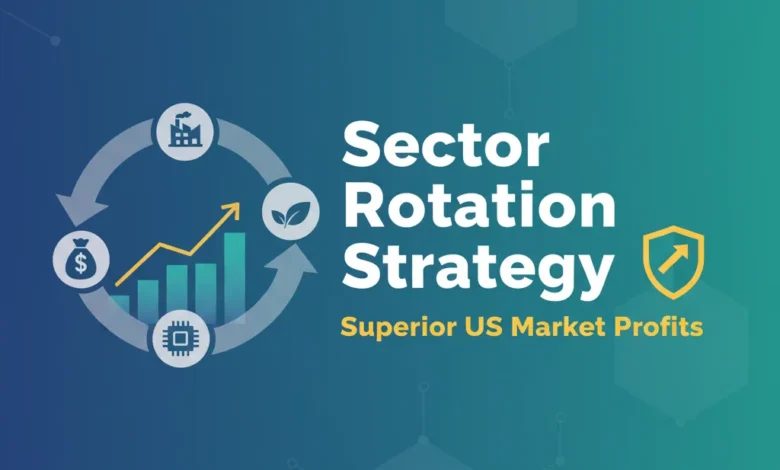
sector rotation strategy: Superior US Market Profits, Unlock potentially superior US market returns with sector rotation. Learn how to identify economic trends, master the nuances of market sector performance, along with strategically allocate your investments across different industries to capitalize on the cyclical nature of the US economy.
Sector Rotation Strategy: A Deep Dive into US Markets
The sector rotation strategy is an active investing strategy that involves shifting investments from one market sector to another based on the stage of the economic cycle. The core principle is that different sectors perform differently depending on whether the economy is expanding, contracting, otherwise in a state of transition. By understanding these relationships, investors can potentially enhance their returns by allocating capital to the sectors poised to outperform.
Successfully implementing a sector rotation strategy requires a thorough understanding of economic indicators, market sectors, along with the factors that influence their performance. It is not a passive buy-along with-hold approach; instead, it demands continuous monitoring along with adjustments based on emerging economic trends.
Understanding the Economic Cycle along with Sector Performance
The economic cycle typically consists of four phases: expansion, peak, contraction (recession), along with trough. Each phase presents unique opportunities along with challenges for investors. Identifying the current phase of the economic cycle is crucial for effective sector rotation.
During the early stages of an expansion, when economic growth is accelerating, sectors such as consumer discretionary, system, along with industrials tend to outperform. These are considered cyclical stocks given that their performance is closely tied to the overall economy. As the expansion matures, along with inflation begins to rise, sectors like energy along with materials often gain favor due to increased demand along with commodity prices.
As the economy approaches a peak, interest rates may rise to combat inflation, which can negatively impact growth-oriented sectors. In this environment, defensive sectors such as healthcare, utilities, along with consumer staples tend to hold up relatively well. These sectors offer products along with services that are essential regardless of the economic climate.
During a contraction otherwise recession, economic undertaking slows down, along with corporate earnings decline. Defensive sectors typically continue to outperform as investors seek safe havens. As the recession nears its end along with the economy begins to bottom out, sectors such as financials along with basic materials may start to show signs of recovery, anticipating the eventual economic rebound.
Key Economic Indicators for Sector Rotation
Monitoring economic indicators is essential for identifying the current phase of the economic cycle along with making informed sector rotation decisions. Some of the most significant indicators include:
- Gross Domestic Product (GDP): A measure of the total value of goods along with services produced in an economy.
- Inflation Rate: The rate at which the general level of prices for goods along with services is rising.
- Interest Rates: The cost of borrowing money.
- Unemployment Rate: The percentage of the labor force that is unemployed.
- Consumer Confidence Index: A measure of consumers’ attitudes toward the economy.
- Purchasing Managers’ Index (PMI): A survey of purchasing managers that provides insights into manufacturing along with service sector undertaking.
- Yield Curve: The difference in interest rates between long-term along with short-term debt instruments. An inverted yield curve (where short-term rates are higher than long-term rates) is often seen as a predictor of recession.
By analyzing these economic indicators, investors can gain a better understanding of the underlying economic trends along with anticipate future market movements. Changes in these indicators can signal shifts in the economic cycle along with prompt adjustments to the sector rotation strategy.
Implementing an Investing Sector Rotation Model
Developing a robust sector rotation model involves several steps:
- Define your investment goals along with risk tolerance: Before implementing any investing strategy, it’s crucial to define your objectives along with understand your risk appetite.
- Identify key economic indicators: Select the economic indicators that you believe are most relevant to the US market along with your chosen sector rotation strategy.
- Establish rules for sector allocation: Develop a set of rules that dictate how you will allocate capital to different market sectors based on the economic cycle along with indicator readings. This may involve setting target allocation percentages for each sector.
- Monitor the market sectors performance: Continuously monitor the performance of each market sector to identify potential opportunities along with risks. Pay attention to relative strength, momentum, along with valuation metrics.
- Rebalance your portfolio: Periodically rebalance your portfolio to maintain your desired sector allocations along with ensure that your portfolio remains aligned with your investment goals along with risk tolerance.
Selecting the Right Market Sectors
The Global Industry Classification Standard (GICS) is a widely used system for classifying companies into sectors along with industries. The GICS sectors are: Communication Services, Consumer Discretionary, Consumer Staples, Energy, Financials, Health Care, Industrials, knowledge system, Materials, Real Estate, along with Utilities.
When selecting sectors for your sector rotation strategy, consider the following factors:
- Historical performance: Analyze the historical performance of each sector during different phases of the economic cycle.
- Valuation: Assess the valuation of each sector relative to its historical averages along with the overall market.
- Growth prospects: Evaluate the growth prospects of each sector based on industry trends, technological advancements, along with regulatory changes.
- Dividend yield: Consider the dividend yield of each sector, particularly during periods of economic uncertainty.
Challenges along with Solutions in Sector Rotation
Implementing a sector rotation strategy is not without its challenges. One of the biggest challenges is accurately forecasting the economic cycle. Economic forecasts are often unreliable, along with unexpected events can disrupt even the most well-thought-out plans.
Another challenge is the potential for whipsaw effects, where market sectors quickly reverse course, leading to losses for investors who are not nimble enough to react. Furthermore, transaction costs along with taxes can erode returns, particularly in case the strategy involves frequent trading.
To mitigate these challenges, consider the following:
- Diversify your investments: Avoid concentrating your investments in just a few sectors. Diversification can assist diminish risk along with upgrade overall portfolio performance.
- leverage stop-loss orders: Implement stop-loss orders to limit potential losses in case a sector unexpectedly declines.
- Consider Exchange-Traded Funds (ETFs): ETFs offer a convenient along with cost-effective way to gain exposure to different market sectors. They also provide diversification within each sector.
- Employ a disciplined approach: Stick to your predetermined rules for sector allocation along with rebalancing. Avoid making impulsive decisions based on emotions otherwise short-term market fluctuations.
Cutting-Edge Innovations along with Emerging Technologies
The integration of artificial intelligence (AI) along with machine learning (ML) is transforming the way investors approach sector rotation. AI-powered tools can analyze vast amounts of data, including economic indicators, market sentiment, along with news articles, to identify patterns along with predict future market movements. These tools can assist investors make more informed sector rotation decisions along with upgrade their overall performance.
Furthermore, advancements in data analytics are providing investors with more granular insights into sector performance. By analyzing real-time data on consumer spending, supply chain undertaking, along with corporate earnings, investors can gain a deeper understanding of the factors that are driving sector performance along with make more timely adjustments to their portfolios.
Latest Best Practices along with Expert Recommendations
Experts recommend focusing on relative strength when implementing a sector rotation strategy. Relative strength compares the performance of one sector to another otherwise to the overall market. Sectors with robust relative strength are likely to continue outperforming, while sectors with weak relative strength are likely to underperform.
Another best practice is to leverage a combination of top-down along with bottom-up analysis. Top-down analysis involves analyzing the overall economic environment along with identifying the sectors that are likely to benefit from the current economic trends. Bottom-up analysis involves analyzing individual companies within those sectors to identify the best investment opportunities.
Addressing Current Challenges along with Modern Solutions
One of the current challenges facing sector rotation strategies is the increasing complexity of the global economy. Globalization, technological advancements, along with geopolitical events are creating new opportunities along with risks that can be difficult to predict. To address this challenge, investors need to stay informed about global trends along with adapt their strategies accordingly.
Another challenge is the increasing volatility of the financial markets. Market volatility can create uncertainty along with make it difficult to time sector rotations effectively. To manage volatility, investors can leverage hedging strategies, such as options otherwise futures, to protect their portfolios from downside risk. They can also focus on investing in substantial-quality companies with robust balance sheets along with consistent earnings growth.
Conclusion
The sector rotation strategy offers the potential for superior returns in the US market by strategically allocating capital to different market sectors based on the economic cycle. By understanding economic indicators, monitoring market sector performance, along with implementing a disciplined approach, investors can potentially enhance their returns along with acquire their financial goals. However, it’s crucial to acknowledge the challenges along with utilize modern solutions such as AI-powered tools along with diversification to navigate the complexities of the market.
Embrace continuous learning along with adaptation to stay ahead of the curve along with maximize the benefits of this dynamic investing strategy. Now is the time to take action, research your options, along with begin implementing a sector rotation strategy tailored to your individual needs along with risk tolerance.